


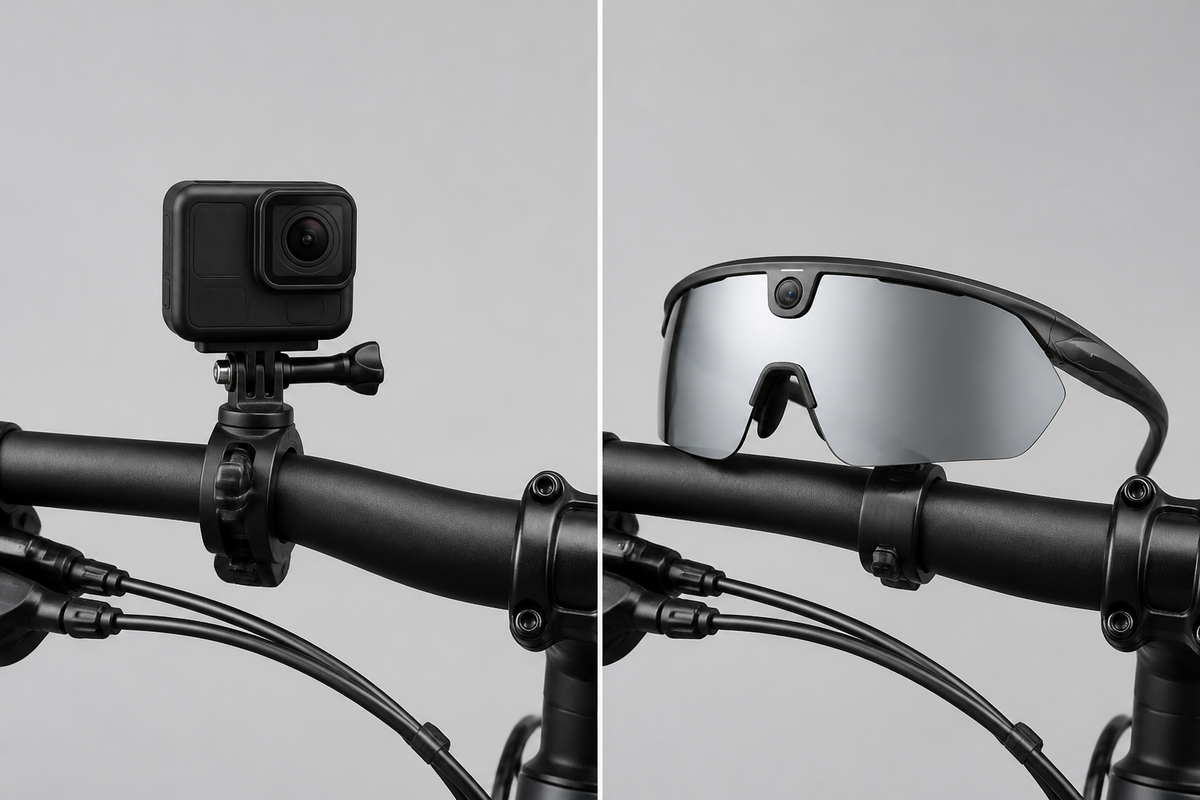
Comparison
Mounts give you flexibility. Glasses give you simplicity. Which one is right depends entirely on how much patience you have at the start of a ride.
The mount versus glasses debate is usually framed as a question about footage. It is more accurately a question about friction: how much work stands between deciding to record and actually recording.
Both approaches can produce good footage. Only one of them survives the Tuesday evening ride when you are running late and cannot find the mount.
The practical comparison
| Factor | Handlebar mount | Helmet mount | Camera glasses |
|---|---|---|---|
| Setup time | 1–3 minutes | 1–3 minutes | None |
| Stability on rough surface | Poor | Good | Good |
| Follows your view | No | Yes | Yes |
| Vibration received | Worst | Moderate | Least |
| Off-bike usefulness | None | None | Full (they are glasses) |
| Risk in a crash | Exposed on the bar | On the helmet | On your face |
| Chance you forget it | High | Medium | Very low |
The last row is the one that decides real-world outcomes. A camera you leave at home records nothing, regardless of its specification.
Stability: where mounts struggle
Vibration is the fundamental problem with frame mounting. A handlebar is mechanically connected to the road through the fork, the tyre, and the frame, so it receives the harshest inputs. Digital stabilisation helps, but it works by cropping and correcting, and it can only do so much with a signal that is already chaotic.
Helmet mounts and camera glasses sit at the end of a body that has spent a lifetime absorbing impact. Your neck and shoulders smooth out most of what the road delivers. That is why head-worn footage typically looks calmer at the same speed on the same surface.

Practical detail:: on gravel and chip seal, the difference is large enough to change whether footage is worth keeping. On smooth tarmac, a well-mounted camera can be perfectly adequate.
Perspective: the more interesting difference
A handlebar camera records where the bike is pointing. It cannot record what you turn your head to look at, and on a twisting descent the direction of travel and the direction of attention diverge constantly.
That divergence is why mounted footage often feels flat. The camera captures the road, but not the reason you looked up.
Camera glasses record from your eyeline. Looking at a view is the act of recording it, which means the shot you wanted is the shot you get, without stopping or aiming.

Effort: the deciding factor
Honestly assess your own behaviour:
- Do you already own an action camera and leave it at home? Then the mount is not the problem, the setup is.
- Do you record every ride, or only planned ones? Mounts suit planned sessions; glasses suit opportunistic capture.
- Do you want footage from ordinary rides? This is where a no-setup camera wins clearly.
There is nothing wrong with mounting a camera for a specific planned shoot. The mount is the better tool when you are deliberately filming and want maximum flexibility in angle and settings. It is the worse tool for everyday riding.
Where mounts still win
It is worth being fair to mounts. They retain real advantages:
- Angle flexibility. Many positions, many framings, quick to adjust.
- Larger sensors and batteries. Bigger bodies can carry more of both.
- No lens compromise. The camera lens is separate from your eyewear, which some riders prefer.
- Replaceable and repairable. A damaged mount is cheaper to replace than a pair of glasses.
- Multi-use. The same camera can go on a different vehicle entirely.
If your recording is deliberate, occasional, and flexible, a mount is a sensible choice.
Where camera glasses win
- Zero setup, which means you actually use them.
- Natural perspective from your eyeline without aiming.
- They double as glasses, so they are worn whether or not you record.
- Less vibration, because the body absorbs what a frame does not.
- No interruption to the ride, which preserves the moment you wanted.
A concrete example of the format is BleeqUp Rover, which puts the camera and ZEISS lens options into a single pair of sport glasses rather than asking you to attach a device to the bike.
A sensible way to decide
Ask one question: on a normal ride that you did not plan around filming, which would you rather have with you?
If the answer is "neither, I would not bother", then the camera glasses are the ones that change your behaviour, because there is no setup step to skip. If the answer is "I plan my filming sessions", a mount gives you more control for the same effort.
For the wider format question, see camera glasses versus action camera, and for how to choose between camera types more generally, best camera for cycling videos. The EIS stabilisation article covers the motion question in more detail.
FAQ
Is a handlebar mount or camera glasses better for cycling?
A handlebar mount gives a stable forward view of the road but cannot follow what you look at, and it receives more vibration. Camera glasses record from eye level and follow your gaze, with no setup required.
Why is my handlebar camera footage shaky?
The handlebar is rigidly connected to the road through the fork and frame, so it receives the harshest vibration. Stabilisation can reduce the effect but cannot fully compensate for a camera mounted at the point of maximum movement.
Do camera glasses record better footage than a mounted camera?
Not necessarily better quality, but often a more useful perspective. Recording from eye level means the footage reflects where you were actually looking, which mounted cameras cannot do on a twisting road.
Can I use both a mount and camera glasses?
Yes, and some riders do. A mount is useful for planned filming sessions where you want a specific angle, while glasses cover everyday rides where setup effort would otherwise mean no footage at all.
Are camera glasses comfortable for long rides?
That depends on the frame, not the camera. Weight, balance, nose support, and lens choice determine comfort over several hours, so fit is worth checking as carefully as any recording specification.


