


Everyday
Nobody sets up a camera to film a walk to the shop, a market, or a child explaining something at the kitchen table. Those are exactly the things worth keeping, and they are exactly what a phone in a pocket never captures.
Sports footage is a solved problem. You know when it starts, roughly what will happen, and why you want it. Everyday footage has none of that structure, which is why it almost never gets recorded.
The reason is not that people do not care. It is that the phone in your pocket has to be reached for, unlocked, aimed, and put away — and that sequence is long enough that by the time you have finished it, the thing has passed. This is the entire case for a camera you wear: it removes the reaching-for.
What everyday footage is worth
It is easy to be vague here, so be specific. Three kinds of everyday footage actually get watched again.
The ordinary Tuesday. Not the holiday — the walk to school, the market on a Saturday, the dog on the same route it does every evening. Footage of a normal day is the thing people go looking for ten years later, and nobody has any, because who films a normal day.
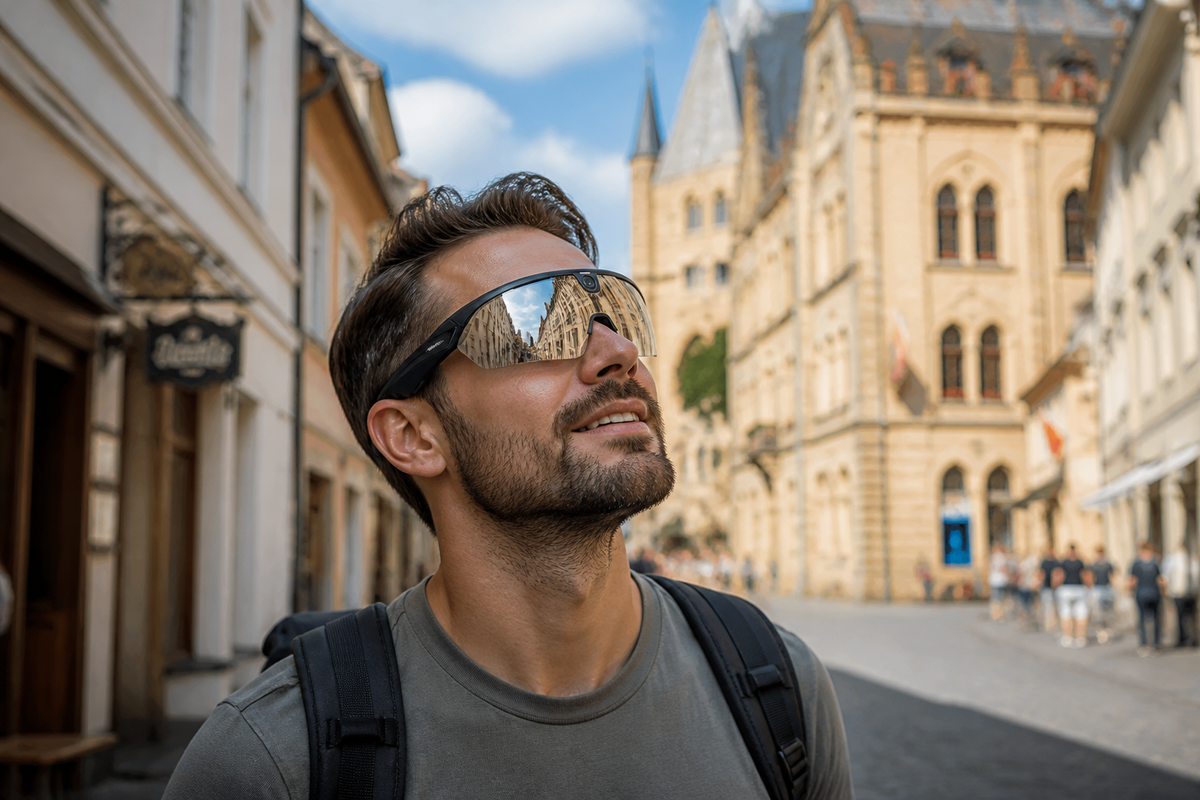
Travel, at eye level. A travel video shot on a phone is a video of a phone being held up. A travel video shot from your face is a video of you looking at something — the turn of a corner, the moment the street opens out, someone explaining something you did not understand. The second one is what people actually watch.
Things that are over before you get the phone out. A child saying something funny, a band in a square, a sudden rain shower, a bird. These are the entire category of footage that camera glasses exist for.
Notice that none of these are "content". If you are making content, you will set up a shot and a phone will be better. This is memory, and memory has different requirements: it needs to be captured with zero effort, at the moment, in the first person.
The honest friction: wearing a camera changes the room
This is the part camera-glasses marketing skips. A camera on your face is visible. People notice, and some of them change how they behave.
In a sporting context that does not matter — everyone is busy being recorded doing something. At a dinner table it matters a lot. The realistic rules:
- Tell people. "These record" is a complete sentence and it takes two seconds. Not telling people is the thing that turns a useful device into a social problem.
- Turn it off for conversations. The most common complaint about camera glasses is not privacy in the abstract, it is the sense that a conversation might be recorded.
- Do not film children you are not responsible for. Schools, playgrounds and pools have their own rules, and other parents have their own views.
- Assume anything you record in public may end up online, including by someone else, and behave accordingly.
The battery maths that decides how you use it
Here is the number that shapes everyday use: about one hour of continuous recording.
That sounds short, and for a sports session it is. For everyday recording it is close to irrelevant, because everyday footage is captured in fifteen-second bursts. Ten clips of a street corner, a market stall and a child on a scooter use perhaps three minutes of that hour.
The pattern that works is different from sport: leave the glasses off-record, and start recording when something is happening. There is no session to record, so nothing to lose by not recording.
Two supporting numbers worth knowing:
- Storage is not the constraint. 32GB is roughly four and a half to five and a half hours of 1080p30 — far more than a month of casual clips.
- Audio playback is about eight hours, which is the part that makes them usable as ordinary glasses rather than a camera you take off.
And the one habit that matters: pull the footage the same week. Loop recording will overwrite the oldest clips as storage fills, which is genuinely useful for a camera you wear every day and genuinely bad if the only clip of the year was on it.

What actually makes everyday footage watchable
Three things, and none of them are about resolution.
Do not narrate. A running commentary dates instantly and is embarrassing within a month. Let the sound be the sound.
Keep clips short. Ten to thirty seconds. An eye-level camera has no framing control, so the interest comes from the moment, not from the composition. Long clips of a walking view are unwatchable.
Do not edit as you go. The instinct is to review and delete immediately. The value of everyday footage is cumulative — a folder of small moments is worth more than the three you judged best at the time.
If you want a structured artefact rather than raw clips, the AI video roadbook is the feature designed for exactly this: it pulls the route, the data and the footage together into a single recap. It is sports-shaped, so it works best on a ride or a run, but the underlying idea — that footage nobody assembles is footage nobody watches — applies to the everyday case too. How the AI video roadbook works covers it.
Where this fits next to a commute camera
There is obvious overlap with commuting, and it is worth being clear about the difference. A commute camera is a *record*: you want the junction, the near-miss, the incident if there is one. An everyday camera is *memory*: you want the market, the walk, the street.
Both are served by the same property — that the camera is already on your face — and both fail for the same reason, which is that people stop wearing it. If you want the commuting-specific case, including the hazard-detection behaviour, camera glasses for commuting is the companion piece.

The honest case against
It is not for everyone, and three objections are fair.
You may not want to be recorded either. A camera on your face is a camera pointed at what you look at, all day. Some people find that changes how they behave, and noticing that you are constantly aware of it is a reasonable reason to stop.
The social cost is real for some people. If your family or friends dislike being filmed, the device will spend its life in a case. That is a legitimate outcome, and no amount of image quality fixes it.
Your phone is already good. In good light, a modern phone produces better footage than any small camera, and the only thing it lacks is immediacy. If you have the discipline to take the phone out, you do not need this.
The case for it is narrow and specific: you want footage of things that are over in fifteen seconds and you will not reach for a phone. If that describes you, this is the one product category where "worn" genuinely beats "carried".
Specifications for Rover — 120° field of view, 3K60 HDR, IP65, 53g, 32GB or 64GB — are on the BleeqUp Rover product page.
FAQ
How much can I record in a day?
About one hour of continuous recording on the internal battery. In practice that is a lot, because everyday clips are fifteen to thirty seconds each — a full day of casual recording typically uses a few minutes of it.
Can I wear them as normal glasses all day?
Yes. They weigh 53g, use open-ear audio and have UV400 lenses, and audio playback runs for around eight hours — considerably longer than the one-hour recording budget. Most people leave them on and record selectively.
Do people notice I am recording?
They notice the glasses, and some will ask. That is why telling people is the right default: "these record" is a two-second sentence and it prevents the only social problem this category reliably creates.
Is the footage good enough to share?
In good light, yes. It is 3K or 1080p footage from a small sensor, so it will not match a phone in low light, but for short, well-lit everyday clips it is entirely serviceable. The limit is the moment, not the resolution.
What happens when the storage fills up?
Loop recording overwrites the oldest footage, so recording never stops. That is convenient day to day and dangerous for the one clip you meant to keep, which is why pulling footage weekly matters.


