


Community
Roc d'Azur draws 19,000 riders to the Var coast. Aurélien Fontenoy arrived with three junior world titles, three elite world silver medals, and a habit of doing things nobody asked him to do.
Roc d'Azur has been running since 1984, when seven riders turned up for the first edition. Forty-two editions later it fills five days on the Côte d'Azur with racing, gravel, trail running and an exhibition ground large enough to get genuinely lost in. This October, 19,000 people registered to ride it.
Aurélien Fontenoy came for the same reason as everyone else, and for one of his own: he does not compete any more, and he still cannot leave a bike alone. He was there alongside the crowd the event itself spends five days assembling, and the weekend shows up in his own feed at @aurelien_fontenoy as well as the event's @rocdazur.
Roc d'Azur, in numbers
The event sits at the Base Nature François Léotard in Fréjus, with courses running out into the Maures and Estérel ranges. The headline race is 55 km with 1,275 m of climbing, and it is the one the television cameras follow. The marathon the day before covers 100.6 km. Around all of that, roughly 300 exhibitors set up for four days and close to 100,000 people walk through.
What makes it unusual is that none of those numbers describe the thing people actually come for. The racing is the spine of the week, but the village is the body: test bikes, team stands, riders who have not seen each other since the last round of something, and a permanent low hum of someone revving a bike they are not supposed to be riding there.
The rider who measures in millimetres
Fontenoy raced bike trials from 2002 until 2019. In 2006, at Rotorua, he won the junior world title on a 26-inch bike. In 2007, at Fort William, he won both junior titles on offer, 20-inch and 26-inch. Three junior world championships, and then a career spent knocking on a door that other people kept closing.
At elite level he finished second at the world championships three times: Leogang in 2012, Pietermaritzburg in 2013, Lillehammer in 2014. He won a World Cup round in Kraków in 2016. Seven wins and 34 podiums across 135 events is an honest record, and it is also a record that leaves the sport's biggest prizes just out of reach, which is a particular kind of education.
Trials is scored on precision rather than speed. A section is a few metres of rocks, pallets and concrete, and you lose points for putting a foot down. The margins are not hundredths of a second; they are whether a tyre edge held. Riders who grow up in that discipline develop a specific relationship with their own line of sight, which is where this weekend gets interesting.## What a trials rider sees that a race camera never does
A race camera stands where the sponsor wants it. It films a rider who is by definition somewhere else. That is fine for a results broadcast and useless for understanding how a rider reads terrain.
Fontenoy's instinct is the opposite: look at the ground in front of the wheel, then look where you want to land. It is a scanning pattern, and it is fast, and no fixed camera has ever captured it. When you put the lens at his eye level, the footage stops being about the bike and starts being about the decision.
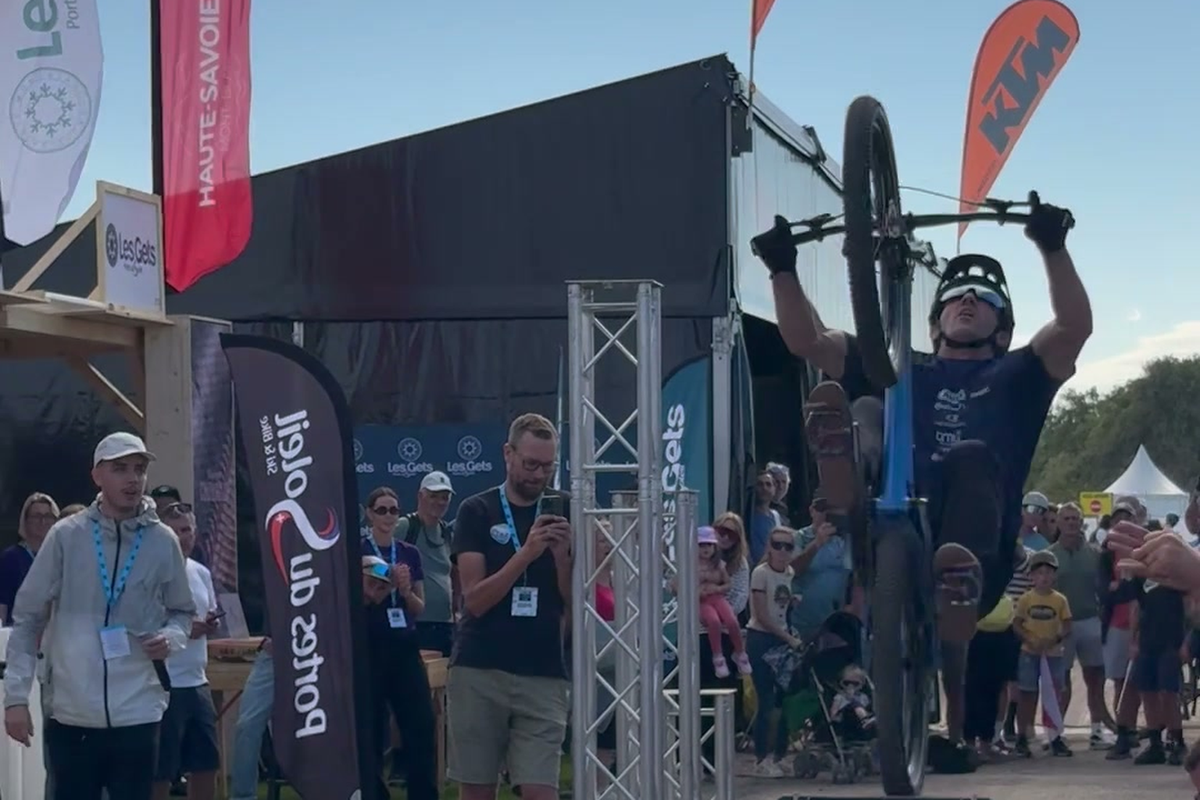
Take the backflip. From the ground it is an event: a rider goes up, rotates, comes down. From eye level it is a sequence of corrections, each one happening a fraction before it needs to. The second version is the one that teaches anything, whether you are the rider reviewing it or a spectator trying to understand why the landing looked easy.
Context: Fontenoy left competitive racing five years ago and now spends most of his time making the kind of content that gets a trials bike onto things it has no business being on. In 2025 he rode up the Eiffel Tower, all 686 steps of it, in 12 minutes 30 seconds, taking nearly seven minutes off a record that had stood since 2002. His own explanation for the pivot is more practical than philosophical: "When you are in the small sports like bike trials, it's very hard to live with only competitions."
Inside the village
The other half of the footage is a walk. No bike, no stunt, no scoreboard, just the exhibition ground at eye level on a bright October afternoon: team tents, flags, a crowd three deep around a ramp, a rider being interviewed into a microphone, someone's dog entirely uninterested in any of it.
This is the part of the weekend that the race broadcast cannot show and that regulars will tell you is the actual event. Roc d'Azur works because it is a gathering first and a race second, and the walk through the village is where that becomes obvious.

Recording without a crew
Most of what makes this footage watchable is not a camera decision, it is the absence of one. There is no rig to build, no operator to coordinate, and no reason to interrupt a conversation to go and check a screen.
That matters more in trials than in most disciplines, because the interesting moments are unrepeatable. You get one attempt at a line, and if the camera required a setup, the attempt would have to be staged around it. A phone on a tripod films a performance; something worn on the face films the work.
Rover is the second-generation BleeqUp AI sports glasses. It carries a Sony 16MP sensor shooting 3K60 HDR video and 4K stills, a 64 GB onboard store, and a lens that clicks between three fixed angles (−10°, 0° and +15°) so the framing can be set for a head-down trials posture or a head-up walking one. It weighs 53 g. Continuous recording from the glasses runs about an hour, extended to roughly five hours with the matching power bank, subject to settings and conditions. If you want the wider buying picture rather than the weekend story, what actually decides a cycling camera and the recording-accessory side cover it; for how the format behaves across different sports, camera glasses by discipline is the honest version.

The point is not that eyewear is better than a dedicated action camera at everything. It is that the best camera is the one already on your face when something worth keeping happens. At an event where most of the good material is unplanned, that difference decides whether you come home with anything at all.
What comes next
Roc d'Azur 2026 closed on 11 October with Jordan Sarrou taking a sixth win on the 55 km course. The 43rd edition is already dated: 6 to 10 October 2027, same coastline, same massifs.
Fontenoy's calendar is less fixed. He has said his plan is to climb the biggest towers in the world, one at a time, and that the last one would be the tallest of them all. Between Roc d'Azur and that, there will be a lot of riding that nobody is paid to film.
Some of it will be recorded anyway.
FAQ
What is Roc d'Azur and where is it held?
Roc d'Azur is an annual mountain bike festival held in Fréjus on the French Côte d'Azur, based at the Base Nature François Léotard with courses in the Maures and Estérel ranges. It has run since 1984 and combines racing across mountain biking, gravel and road with trail running, hiking and a large exhibition village.
Who is Aurélien Fontenoy?
A French bike trials rider who competed from 2002 to 2019. He won three junior world championships (2006 in Rotorua, and both junior titles in 2007 at Fort William) and finished second at elite world championship level three times, in 2012, 2013 and 2014. He now focuses on content creation and record attempts, including riding up the Eiffel Tower in 2025.
Why film a mountain bike event on camera glasses instead of an action camera?
Because the interesting moments are unplanned. A helmet or bar mount has to be set up, aimed and remembered; eyewear is already in place, so the cost of capturing something is close to zero. The trade-off is that the footage follows your head rather than the bike, which is a limitation for technical analysis and an advantage for first-person storytelling.
How long can BleeqUp Rover record for?
Roughly one hour of continuous video from the glasses, extended to about five hours with the matching power bank, subject to settings and conditions. Clip length limits differ by recording mode, so the mode you choose determines whether you are recording continuously or in bursts.
Is this footage from a professional film crew?
No. The clip was recorded on BleeqUp Rover during the 2026 edition of Roc d'Azur. The backflip sequence was filmed at the event by the team, and the walk through the village is the glasses' own first-person view.


